

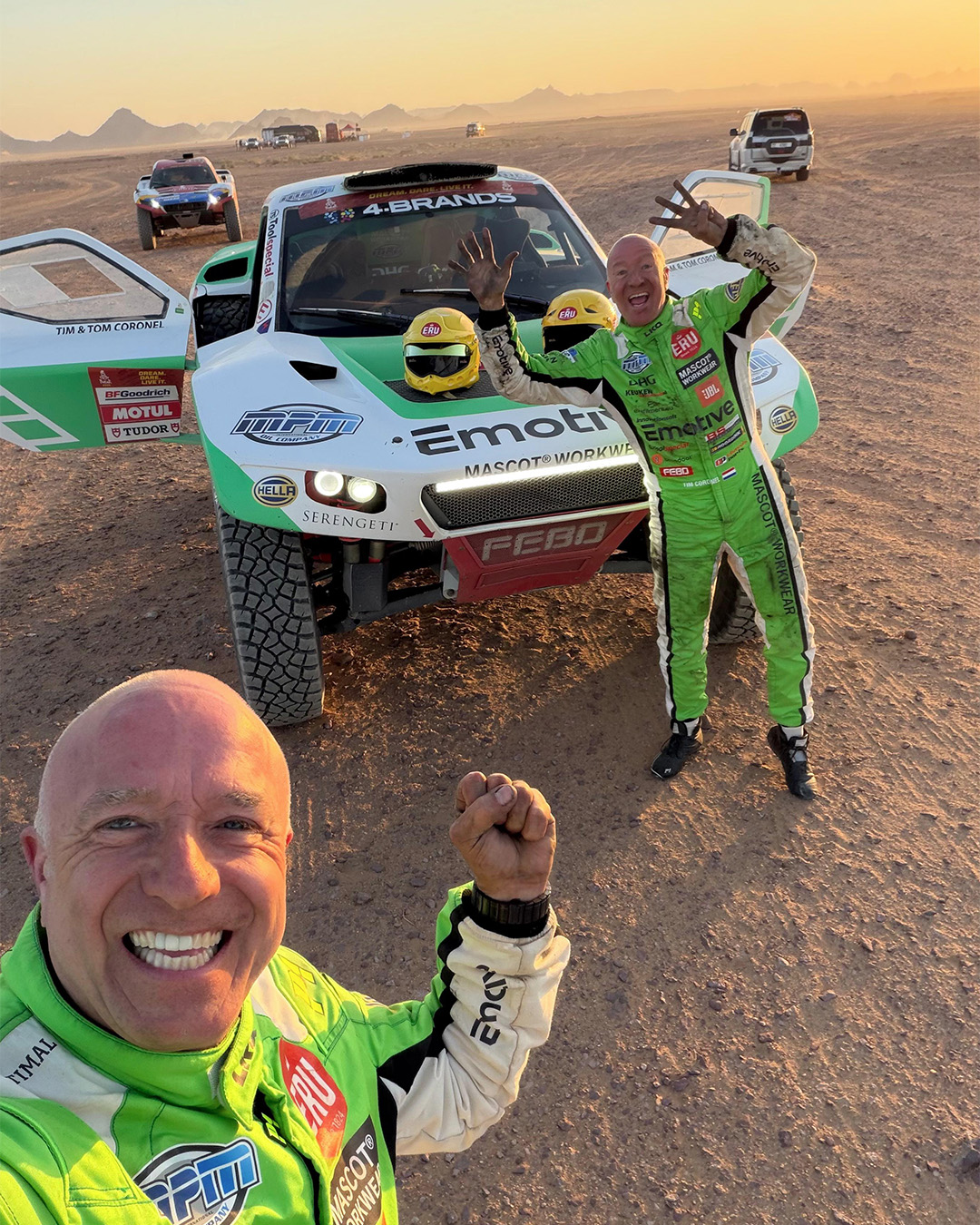
WADI AD DAWASIR (January 12, 2026) – The longest stage of the Dakar Rally turned into a survival test for Tim and Tom Coronel. After a strong start through the dunes, the brothers had to stop for an hour to replace a driveshaft, and later faced more issues. They finished the stage two hours behind the day’s winner but arrived safely. “I didn’t see this coming. It was much tougher than I expected,” says Tom.

The 481-kilometer loop around Wadi Ad Dawasir started promisingly. “We were doing really well through the dunes. It was quite a long dune ride, but it went really, really well,” Tom explains. Tim agrees: “Very varied, beautiful dunes, some massive ones too, it was really challenging.”
Halfway through the dunes, the brothers were driving behind Mark Mustermann and Martin van den Brink, who got stuck. “We were heading toward their rear and ended up getting stuck ourselves. There was nowhere to go, we were on the dune,” Tom says. “I jumped out quickly to call for help, and then we managed to get moving again. Just in time.”
Replacing a driveshaft in the desert
After 200 kilometers, things went wrong. “The car wasn’t pulling anymore. I looked and thought, ‘Okay, we have a flat tire.’ Then I saw, ‘Oh shit, it’s not just a flat tire,’” Tom recalls. Long ropes hanging on the sand plates had wrapped around the driveshaft, tearing the boot.
Tim and Tom got to work. “Tim and I replaced the driveshaft. I took the new one off and put the old one back on the side of the car with the spare parts. Tim then fitted the new driveshaft. It took an hour,” Tom explains. “Replacing a driveshaft in the desert isn’t the easiest or prettiest job. Sand everywhere and the wind was blowing. But we managed.”
For Tim, it was mainly a mental challenge. “You know you’re going to lose some time, so you have to reset your mind,” he says. “After that, we just kept going and picked up the pace again. The navigation went well, everything went well. We had a nice flow going.”

Through ravines and over rocks
After the repair, the stage’s character changed completely. “Very bumpy, suddenly lots of rocks. Unbelievable, through ravines, through wadis, nothing but rocks,” Tom says. “There were some really nice navigation tricks, and everything went really well.”
Tim enjoyed this part the most. “Through the canyons, over rocks, up and down, it was just insane. I’d say this was definitely one of my favorite parts,” he says. “I was really enjoying myself.”

On the rocks, Mustermann got stuck again. “We pulled him out. But while we were pulling him out, we probably damaged the clutch or driveshaft. We’re not exactly sure,” Tom says. “We took it easy on the car and then drove very carefully because we wanted to bring it home.”
Slipping and driving carefully
The problem showed itself as slipping. “We don’t know if it’s the right rear driveshaft or a differential starting to grind because we had to pull it loose. Or maybe the clutch, but we felt some slipping, and from that moment on, we just made sure it didn’t slip anymore.”
Despite all the problems, Tim and Tom made it in before dark. “My hands are black from all the wrenching and trouble,” Tom says. “But we made it. Now we still have to drive 250 kilometers back to the bivouac, but we’re here.”

Tough marathon stage with extra pit stop
Tomorrow, the second marathon stage starts toward the refuge camp in Bisha, another test of endurance; physically, mentally, and mechanically. The course will be treacherous with rocky sections demanding speed and control through countless changes of pace. At the end of the special stage, a beautiful dune passage offers a preview of what’s to come.
The organization has decided to add an extra pit stop. In this Remote Service Zone, teams can provide light assistance along the way. As in the first week, cars and bikes will follow separate routes, and at the finish, a sparse refuge camp awaits where the brothers will have to fend for themselves.